

Blog
Manual Trading vs. Expert Advisor (EA): What Are the Pros, Cons, and Key Differences?

The primary difference between manual trading and using an Expert Advisor (EA) lies in who, or what, makes the final trading decisions. Manual trading grants the human trader complete discretionary control over every action, blending analysis with intuition, while an EA automates trading by strictly following a pre-programmed set of rules without any emotional input or flexibility. Choosing between them depends entirely on your trading style, time availability, and psychological makeup.
For those new to the markets, manual trading is generally the better starting point because it forces you to learn market dynamics, risk management, and emotional control firsthand. An Expert Advisor is better suited for traders who have already developed and tested a profitable strategy and wish to automate its execution to save time or improve discipline.
In terms of direct management over your account, manual trading offers unparalleled control and flexibility, allowing you to react instantly to unexpected news or changing market sentiment. Conversely, an EA provides control over the system’s parameters before you turn it on, but it operates with rigid discipline once active, executing trades based solely on its coded logic.
Ultimately, both approaches have a valid place in a trader’s toolkit. One prioritizes human insight and adaptability, while the other champions systematic consistency and speed. Understanding the specific advantages and disadvantages of each will help you decide which method aligns best with your personal trading goals and personality.
What is Manual Forex Trading?
Manual Forex trading is a method where a human trader makes all buying and selling decisions based on their own analysis, strategy, and discretion, then personally executes those trades through a trading platform. This approach places the trader in the driver’s seat for every single action taken in their account.
To understand this better, let’s explore the core attributes of manual trading. At its heart is human decision-making. A manual trader actively analyzes the market to form a trading hypothesis. This involves two primary forms of analysis. First is fundamental analysis, where the trader examines economic data, interest rate decisions from central banks, geopolitical events, and news reports to gauge the underlying health of a country’s currency. For example, if the U.S. Federal Reserve signals a more aggressive stance on interest rates, a manual trader might decide to buy the U.S. dollar based on the expectation that it will strengthen. The second form is technical analysis, which involves studying price charts. Traders use indicators like Moving Averages, the Relative Strength Index (RSI), and chart patterns like “head and shoulders” or “triangles” to identify potential entry and exit points. A manual trader synthesizes all this information to decide if a trade is worth taking.
Another key attribute is discretion. This is perhaps the biggest differentiator from automated systems. Discretion is the trader’s ability to bend or break their own rules based on experience or current market context. For instance, your strategy might signal a perfect “buy” setup on the EUR/USD pair. However, you notice that the market is unusually quiet right before a major news announcement. Your experience tells you that this could be the “calm before the storm,” so you use your discretion to ignore the signal and wait for the volatility to pass. An automated system would have taken the trade without a second thought. This human element allows a trader to adapt to nuances that are nearly impossible to program into an algorithm.
Finally, manual trading involves direct market interaction. You are not just setting rules; you are actively engaging with the trading platform, such as MetaTrader 5 or cTrader. The process is hands-on: you open the charts, draw your trend lines, calculate your position size based on your risk tolerance, and physically click the “buy” or “sell” button. You then monitor the trade, deciding in real-time whether to move your stop-loss, take partial profits, or close the position entirely. This intimate involvement creates a powerful feedback loop, allowing for a deep and practical learning experience. You see what works and what doesn’t, feel the psychological pressure of managing a live trade, and build an intuitive sense of market flow over time.
What is an Expert Advisor (EA)?
An Expert Advisor (EA) is an automated software program that executes trades on a trading platform, such as MetaTrader 4 or 5, based on a pre-programmed set of rules and algorithms. Essentially, an EA acts as a robotic trader that works on your behalf, removing the need for manual intervention once it is activated.
Let’s break down the key characteristics that define an Expert Advisor. The most important attribute is automation. An EA is designed to monitor the markets and manage trades 24 hours a day, five days a week, without requiring the trader to be in front of their computer. To achieve this uninterrupted operation, traders often run their EAs on a Virtual Private Server (VPS). A VPS is a remote server that stays online continuously, ensuring the EA is never disconnected due to a local power outage or internet failure. This allows the EA to catch trading opportunities across all global market sessions, from Tokyo to London to New York, something a human trader simply cannot do without suffering from extreme fatigue.
At the core of every EA is an algorithm. In the context of trading, an algorithm is just a specific set of instructions that tells the EA what to do under certain conditions. These instructions are typically written in a programming language specific to the trading platform, such as MQL4 for MetaTrader 4 or MQL5 for MetaTrader 5. The logic is based on “if-then” statements. For example, a simple EA’s algorithm might be: “IF the 20-period Moving Average crosses above the 50-period Moving Average, AND the Relative Strength Index (RSI) is below 70, THEN execute a buy order with a stop-loss 50 pips below the entry price and a take-profit 100 pips above.” This logic is executed instantly and precisely every time the conditions are met.
This leads to the third attribute: pre-programmed rules. An EA operates exclusively on the logic it was given. It has no intuition, no ability to read the news, and no discretion to deviate from its code. It doesn’t care if there’s a major political election or if a central bank governor is about to give a speech. It will only analyze the market through the lens of its programmed indicators and rules. While this rigidity can be a weakness in certain market conditions, it is also a major strength. The EA is completely free of human emotions like fear and greed, ensuring that the trading strategy is executed with perfect discipline, time and time again. Before being deployed on a live account, these rules can be rigorously backtested against years of historical price data to see how the strategy would have performed in the past, giving the trader a statistical foundation for their expectations.
What Are the Main Advantages and Disadvantages of Manual Trading?
Manual trading’s main advantages are its supreme flexibility and potential for deep learning, while its primary disadvantages stem from emotional interference and significant time commitment. This method puts you in full command, but that power comes with the full weight of human fallibility.
Whether manual trading is right for you depends on how you weigh these competing factors. For some, the ability to adapt and use intuition is a priceless asset that leads to greater profitability. For others, the psychological pressure and potential for human error make it an unsustainable approach. Let’s explore the specific pros and cons in more detail.
What Are the Pros of Manual Trading?
The primary strength of manual trading is its adaptability to dynamic market conditions. Markets are not static; they are influenced by a constant stream of news, economic reports, and unforeseen global events. A human trader can instantly process a headline about a natural disaster or a surprise political development and decide to close their trades or avoid the market altogether. An EA, by contrast, would continue to follow its technical rules, potentially walking right into extreme volatility. This ability to interpret and react to fundamental information and context gives manual traders a significant edge, especially in news-driven markets.
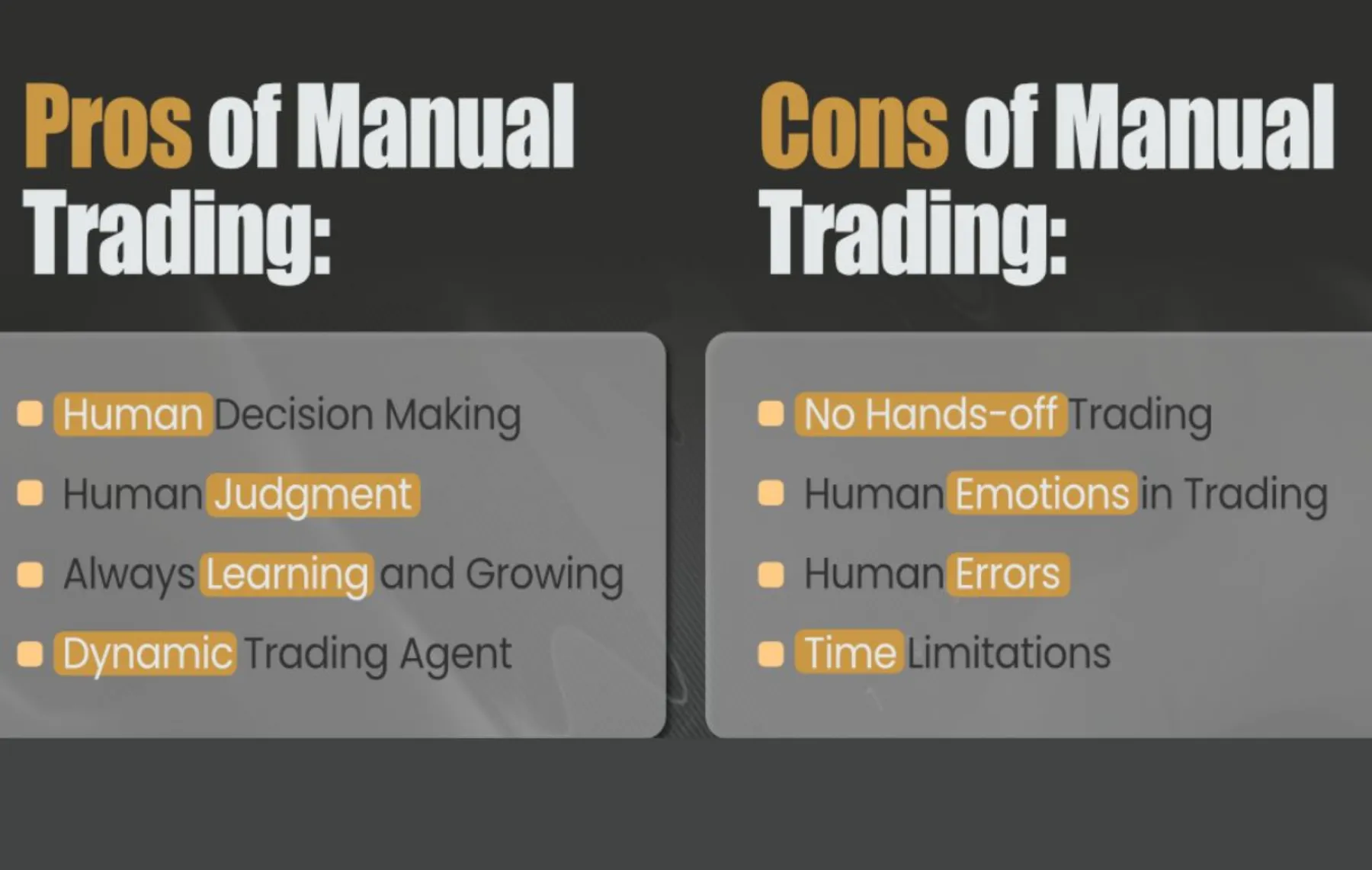
Another major advantage is the use of intuition and experience. Over thousands of hours of screen time, experienced traders develop a “feel” for market behavior that cannot be quantified or coded into an algorithm. They may notice subtle shifts in price action or momentum that signal a potential reversal, even when their technical indicators have not yet generated a formal signal. This intuitive sense, built upon the foundation of countless past trades, allows them to make nuanced decisions, such as exiting a trade slightly early to secure profits before a pullback or holding a position longer because the market momentum feels strong.
Furthermore, manual trading provides full and absolute control over every trade. You decide the exact entry point, the precise stop-loss placement, and the target for taking profits. You can manage the trade as it progresses, perhaps moving your stop-loss to break even or taking partial profits to reduce risk. There is no risk of a software bug or a faulty algorithm running wild and placing unintended trades on your account. Every single outcome, good or bad, is a direct result of your own decisions, which provides a clear sense of ownership and responsibility. This control is empowering and is a key reason many traders prefer this method.
What Are the Cons of Manual Trading?
The most significant drawback of manual trading is its susceptibility to emotional decisions. The two most destructive emotions in trading are greed and fear. Greed can cause a trader to over-leverage their account or refuse to take profits on a winning trade in the hopes of an even bigger gain, only to watch it reverse. Fear can cause a trader to close a winning trade too early, leaving significant profit on the table, or to panic and exit a position during a minor drawdown that would have eventually turned profitable. These emotional reactions often lead to impulsive, irrational decisions that sabotage an otherwise sound trading strategy.
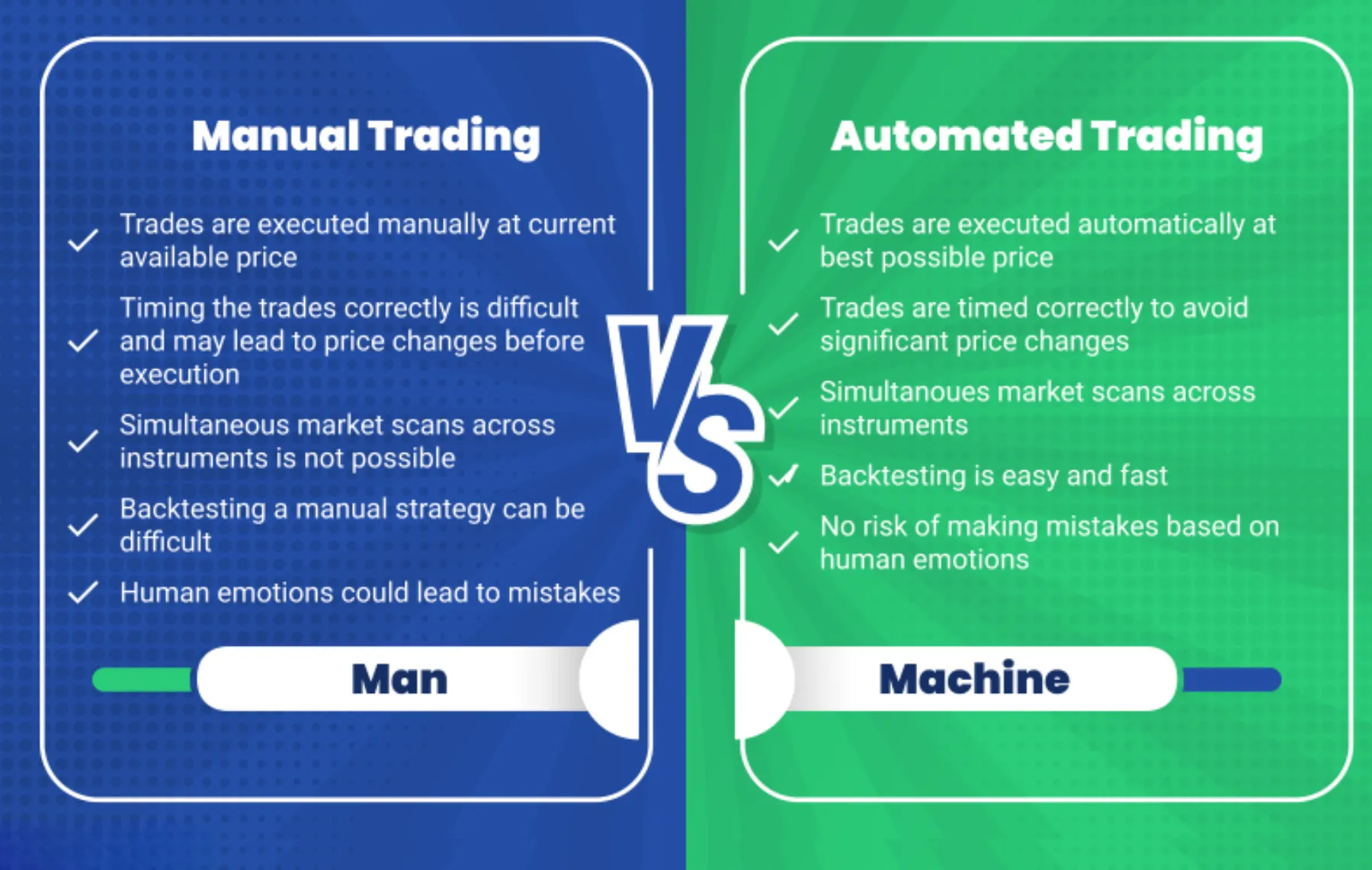
Next, there is the high potential for human error. Even the most disciplined trader can make a simple mistake under pressure. This could be as simple as a “fat finger” error, where you accidentally type an extra zero and enter a position ten times larger than you intended. It could also involve placing a buy order instead of a sell, forgetting to place a stop-loss order entirely, or miscalculating your position size. These small slips can lead to catastrophic losses, and they happen far more often than many traders would like to admit. An automated system, on the other hand, executes with mechanical precision every time, free from such careless mistakes.
Another major con is the limited trading time. The forex market operates 24 hours a day, but a human being cannot. You need to sleep, work, and live your life away from the screen. This means you will inevitably miss trading opportunities that occur during the market sessions you are not able to monitor. A perfect setup might form during the London session while you are asleep in North America, or vice versa. This can be frustrating and may lead to “forcing” trades during your available hours, even when the market conditions are not ideal. Finally, manual trading suffers from slower execution speed compared to an automated system. An EA can analyze data and execute a trade in milliseconds. A human needs time to see the setup, confirm the signals, calculate the risk, and physically click the mouse, during which time the price could move against them.
What Are the Main Advantages and Disadvantages of an Expert Advisor?
An Expert Advisor’s key advantages include its unwavering emotional discipline and 24/5 operational capacity, while its main disadvantages are a lack of flexibility and a complete reliance on its programming quality. An EA is a tool for systematic execution, excelling in areas where human traders are weakest, but it fails where humans often shine brightest.
The decision to use an EA involves a trade-off. You gain speed, consistency, and freedom from emotional stress, but you give up the ability to apply human intuition and adapt to unique market circumstances. Understanding this balance is essential to using an EA effectively. Here is a closer look at the specific pros and cons.
What Are the Pros of an Expert Advisor?
The single greatest advantage of an Expert Advisor is emotion-free trading. An EA operates purely on logic and mathematics. It does not feel fear when the market moves against its position, nor does it feel greed when a trade is in profit. It will hold a trade until the pre-defined stop-loss or take-profit level is hit, or until an exit signal is generated according to its rules. This removes the biggest hurdle for most traders: psychological interference. By automating execution, an EA enforces perfect discipline, ensuring that the trading plan is followed to the letter without any second-guessing or emotional breakdowns.

Another critical benefit is high-speed execution. In fast-moving markets, every fraction of a second can count. An EA can process market data and execute an order in milliseconds, far faster than any human. This speed is a huge advantage in strategies that rely on capturing small, fleeting price movements, such as scalping. It ensures minimal slippage, which is the difference between the expected price of a trade and the price at which the trade is actually executed. This precision can have a substantial impact on the profitability of a strategy over the long term.
EAs also offer the ability to trade 24/5 without fatigue. The global forex market never sleeps during the week, and an EA can monitor all sessions relentlessly. When hosted on a Virtual Private Server (VPS), an EA can run uninterrupted, scanning for opportunities and managing trades while you are working, spending time with family, or sleeping. This opens up a world of possibilities, allowing your strategy to operate on currency pairs that are most active during different time zones, without you having to sacrifice your health or lifestyle.
Finally, a powerful feature of EAs is the capability to backtest strategies on historical data. Before you risk a single dollar of real money, you can run your EA on years of past price data within the MetaTrader Strategy Tester. This simulation shows you how your strategy would have performed under various market conditions, providing key performance metrics like total profit, drawdown, and win rate. While past performance is not a guarantee of future results, rigorous backtesting provides invaluable statistical insight and helps you identify a strategy’s strengths and weaknesses.
What Are the Cons of an Expert Advisor?
The most significant weakness of an Expert Advisor is its inability to adapt to unexpected market conditions. An EA is fundamentally rigid; it only knows how to operate within the context it was programmed for. For example, an EA designed to work well in a trending market will likely suffer significant losses if the market suddenly shifts into a sideways, ranging condition. It cannot recognize a “black swan” event like a flash crash or a surprise central bank intervention. It will blindly continue executing its technical signals, which can be disastrous during periods of extreme, news-driven volatility. A human trader can see the changing environment and stop trading, but an EA cannot.
An EA is also entirely reliant on its programming quality. A poorly written code can contain bugs or logical flaws that lead to unintended consequences, such as opening multiple unauthorized trades or failing to execute a stop-loss. Even a well-coded EA is only as good as the trading strategy it is based on. The popular saying “garbage in, garbage out” is especially true here. If the underlying strategy is flawed, automating it will only help you lose money faster and more efficiently.
A common pitfall for EA users is over-optimization, also known as curve-fitting. This happens when a trader tweaks the EA’s settings so they perform perfectly on a specific set of historical data. The resulting system looks incredibly profitable in backtests, but it often fails spectacularly in live trading. This is because it has been tailored to the unique quirks of the past data and is not robust enough to handle the unpredictable nature of future price movements. A truly effective EA must be built on a sound market principle that works across different timeframes and conditions, not just on a “perfect” set of historical parameters.
Lastly, there is the requirement for a proper technical setup and maintenance. For an EA to run 24/5, it needs a constant, stable connection to the trading server. This typically means renting a Virtual Private Server (VPS) for a monthly fee. You also need to monitor the EA regularly to ensure it is running correctly, check the platform’s journal for any errors, and perform periodic updates or adjustments. It is not a completely “set and forget” solution; it is a piece of technology that requires oversight.
Which Trading Method Offers More Control and Flexibility?
Manual trading offers far more control and flexibility by allowing for discretionary decisions in real-time, while an Expert Advisor provides rigid, disciplined execution based on pre-set rules. The type of control each method provides is fundamentally different, and which one is superior depends on what the trader is trying to achieve.
Let’s explore this comparison in detail. When we talk about control level, it is helpful to think of it in two layers. The first layer is micro-control, which is the management of individual trades. In this area, manual trading is the undisputed winner. A manual trader has absolute command over every aspect of a trade from start to finish. They decide the exact moment to enter, where to place the stop-loss and take-profit orders, and when to close the trade. If market conditions change unexpectedly, they can intervene immediately. For instance, if a promising trade suddenly starts to stall and show signs of weakness, a manual trader can decide to cut the position for a small profit or a minimal loss, even if their original take-profit or stop-loss has not been hit. This granular, hands-on control provides a deep sense of command over one’s capital.
An Expert Advisor, on the other hand, offers macro-control. The trader controls the system, not the individual trades. You set the parameters before you activate the EA: the currency pairs to trade, the lot size, the risk settings, and the specific indicator values. Once it is running, however, you relinquish micro-control. The EA will execute trades based on its algorithm, and you are merely a passenger. While you can intervene and shut it down, its normal operation is fully autonomous. This form of control is about designing and deploying a system and then trusting it to operate as intended.
The second, and perhaps more important, factor is adaptability, which is the essence of flexibility. Here again, manual trading has a distinct advantage. A manual trader can integrate a wide range of information into their decision-making process. They can watch a live speech from a central bank chair, read a breaking news story, and observe market sentiment to inform their actions. If a geopolitical crisis erupts, they can immediately adapt their strategy by reducing risk, hedging their positions, or simply staying out of the market. This ability to react to qualitative, non-programmable information is a uniquely human skill.
An EA lacks this adaptability completely. It is a creature of pure logic and can only react to the quantitative data it was programmed to analyze, such as price and indicator values. It cannot understand context. A news event that fundamentally changes the market landscape is just another series of price ticks to an EA. This rigidity can be a severe liability in rapidly changing or crisis-driven markets, where old patterns no longer apply. Therefore, if your trading strategy relies on navigating complex events and market sentiment, manual trading’s flexibility is essential. If your goal is to execute a purely mechanical strategy with perfect discipline, the rigid control of an EA is more suitable.
Which Trading Style is Better for Different Types of Traders?
Manual trading is best for beginners learning the market and for experienced discretionary traders, while EA trading is ideal for part-time traders who lack screen time and for systematic, quantitative traders. There is no universally “better” method; the optimal choice depends directly on a trader’s experience level, time availability, personality, and trading philosophy.
Choosing between a hands-on approach and an automated one is a critical decision that will shape your entire trading journey. By matching the method to the individual, a trader can leverage their personal strengths and mitigate their weaknesses. Here is a guide to help you determine which style might be the best fit for you.
Is Manual Trading Better for Beginners or Experienced Traders?
For beginners, manual trading is not just better; it is essential. The initial phase of a trading career is about education, and there is no substitute for hands-on experience. By manually analyzing charts, placing trades, and managing positions, a new trader builds a foundational understanding of how markets work. They learn to read price action, understand the impact of news events, and, most importantly, confront their own psychological tendencies. Making mistakes, losing small amounts of money, and analyzing what went wrong is a powerful learning process. Jumping directly to an EA would be like trying to become a pilot by only using the autopilot. You might get from point A to point B, but you will have no idea how to actually fly the plane when turbulence hits.
For experienced traders, manual trading is where their hard-earned skills truly shine. After years of market exposure, a veteran trader develops a deep, intuitive sense of market dynamics. Their discretion is no longer a liability driven by emotion but a powerful asset guided by experience. They can expertly blend technical analysis with a fundamental overview of the market, making high-level decisions that a purely technical EA could never replicate. They know when to follow their system religiously and when the context warrants a deviation. For these professional discretionary traders, manual trading provides the flexibility needed to perform at the highest level.
Is EA Trading Better for Part-Time or Full-Time Traders?
EA trading is an excellent solution for part-time traders. Many people are drawn to forex trading but already have demanding full-time jobs or other commitments. They simply do not have the hours to sit in front of a screen monitoring charts, especially if the best trading opportunities for their chosen currency pair occur during their working hours. An EA solves this problem perfectly. A part-time trader can spend their weekends developing or testing a strategy, and then deploy an EA to execute that strategy automatically during the week. It allows them to participate in the markets and pursue their financial goals without having to quit their day job.
For full-time traders, EAs can also play a valuable role, particularly for those who specialize in quantitative trading. These “quants” are traders who focus on developing and deploying strategies based on statistical analysis and mathematical models. For them, the EA is the primary tool for executing their complex, data-driven ideas. Additionally, even a full-time discretionary trader might use EAs to diversify their approach. For example, they might manually trade their primary strategy on the daily charts while letting a portfolio of EAs trade different, non-correlated scalping strategies on shorter timeframes. This allows them to scale their operations and smooth out their equity curve by combining different trading styles.
What Are the Advanced Considerations for Manual and EA Trading?
Advanced considerations involve exploring hybrid trading models, understanding the full cost of ownership for EAs, validating performance through rigorous testing, mitigating technical risks, and knowing the underlying programming languages for customization. Additionally, moving beyond a simple comparison of manual versus automated trading reveals a more complex picture where technical proficiency, financial investment, and risk management become central themes.
Can You Combine Manual Trading with an Expert Advisor?
A trader can absolutely combine manual oversight with an Expert Advisor, a practice known as hybrid or semi-automated trading. This approach allows traders to leverage the strengths of both methodologies. An EA can be programmed to scan markets 24/7 for specific setups based on a predefined strategy, generating alerts when conditions are met. Instead of executing the trade automatically, the EA notifies the trader, who then performs a final manual review. This “human in the loop” model allows the trader to apply discretion, consider broader market context like news events, and veto trades that look good on paper but feel wrong based on experience. Another common hybrid strategy involves using an EA for trade management. For instance, a trader might manually enter a position, but then activate an EA to manage the stop-loss, take-profit, and trailing stop levels automatically, freeing them from constant chart monitoring.

This implementation of a hybrid strategy offers a balanced approach to the market.
- Signal Generation: Use an EA to identify potential trading opportunities across multiple currency pairs or timeframes without manual effort.
- Discretionary Execution: Make the final buy or sell decision yourself, incorporating intuition and analysis of qualitative factors.
- Automated Management: Let an EA handle the exit strategy, securing profits or cutting losses according to strict rules once a trade is live.
What Are the Costs Associated with Using an Expert Advisor?
Beyond the initial excitement of automation, there are several real costs associated with using an Expert Advisor. These expenses can add up and should be factored into your trading budget. The most obvious is the purchase price of the EA itself. A quality, well-coded EA from a reputable developer can range from a few hundred to several thousand dollars. Be wary of cheap or free EAs, as they often rely on flawed strategies. Another major ongoing expense is a Virtual Private Server (VPS). Since EAs need to run 24 hours a day, five days a week, a VPS is a necessity to avoid downtime from internet outages or computer shutdowns. A reliable VPS typically costs between $20 and $50 per month. Lastly, there are potential costs for customization and optimization if the off-the-shelf EA does not perfectly match your risk tolerance or trading style. Hiring a programmer to make adjustments can be expensive.
This total cost and investment goes far beyond the initial software purchase.
- One-Time Purchase or Subscription: The upfront cost to acquire the Expert Advisor license, which can be a single payment or a recurring fee.
- VPS Hosting: A monthly fee for a remote server that guarantees your trading platform and EA remain online and connected to your broker continuously.
- Optimization and Development: Potential fees paid to MQL developers for tweaking the EA’s code, adding new features, or optimizing its parameters for different market conditions.
How Important is Backtesting and Forward Testing for an EA?
Backtesting and forward testing are not just important; they are absolutely essential for validating an Expert Advisor’s viability. Skipping these steps is like flying a plane without a pre-flight check. Backtesting is the process of applying an EA’s trading rules to historical price data to see how it would have performed in the past. It provides a baseline understanding of the strategy’s potential profitability, drawdown, and win rate. However, backtesting has limitations, as it can be prone to “curve fitting,” where a strategy is over-optimized for past data and fails in live conditions. This is where forward testing, also known as paper trading or demo trading, becomes critical. Forward testing involves running the EA on a live or demo account in real-time market conditions without risking real money. This process validates the backtested results and reveals how the EA performs with real-world factors like slippage, broker execution speed, and changing spreads.

A thorough testing protocol is the only way to build confidence in an automated strategy.
- Backtesting: This historical simulation reveals the theoretical performance of the EA. The MetaTrader platforms have a built-in Strategy Tester for this purpose.
- Forward Testing: This real-time simulation confirms if the EA can replicate its backtested performance with live data feeds and broker variables.
- Combined Validation: A strategy is only considered robust if it shows positive results in both extensive backtesting and a lengthy forward testing period of at least several months.
What Are the Main Technical Risks of Relying on an EA?
While a flawed strategy is a primary risk, traders relying on EAs also face significant technical dangers that can lead to unexpected losses. This technological dependency means that any single point of failure in the technical chain can disrupt trading operations. A common issue is a loss of internet connectivity at the trader’s location or, more critically, at the VPS provider. If the connection to the broker’s server drops, the EA cannot manage open trades or execute new ones. Similarly, the trading platform itself, like MetaTrader 4 or 5, can freeze or crash, rendering the EA useless until the platform is restarted. The VPS itself could experience downtime due to hardware failure or maintenance, taking your EA offline with it. Even if everything on your end works, broker-side issues like high execution latency or requotes during volatile periods can cause the EA’s performance to deviate sharply from its backtested results. Finally, a bug within the EA’s code could cause it to open erroneous trades or fail to close positions correctly.
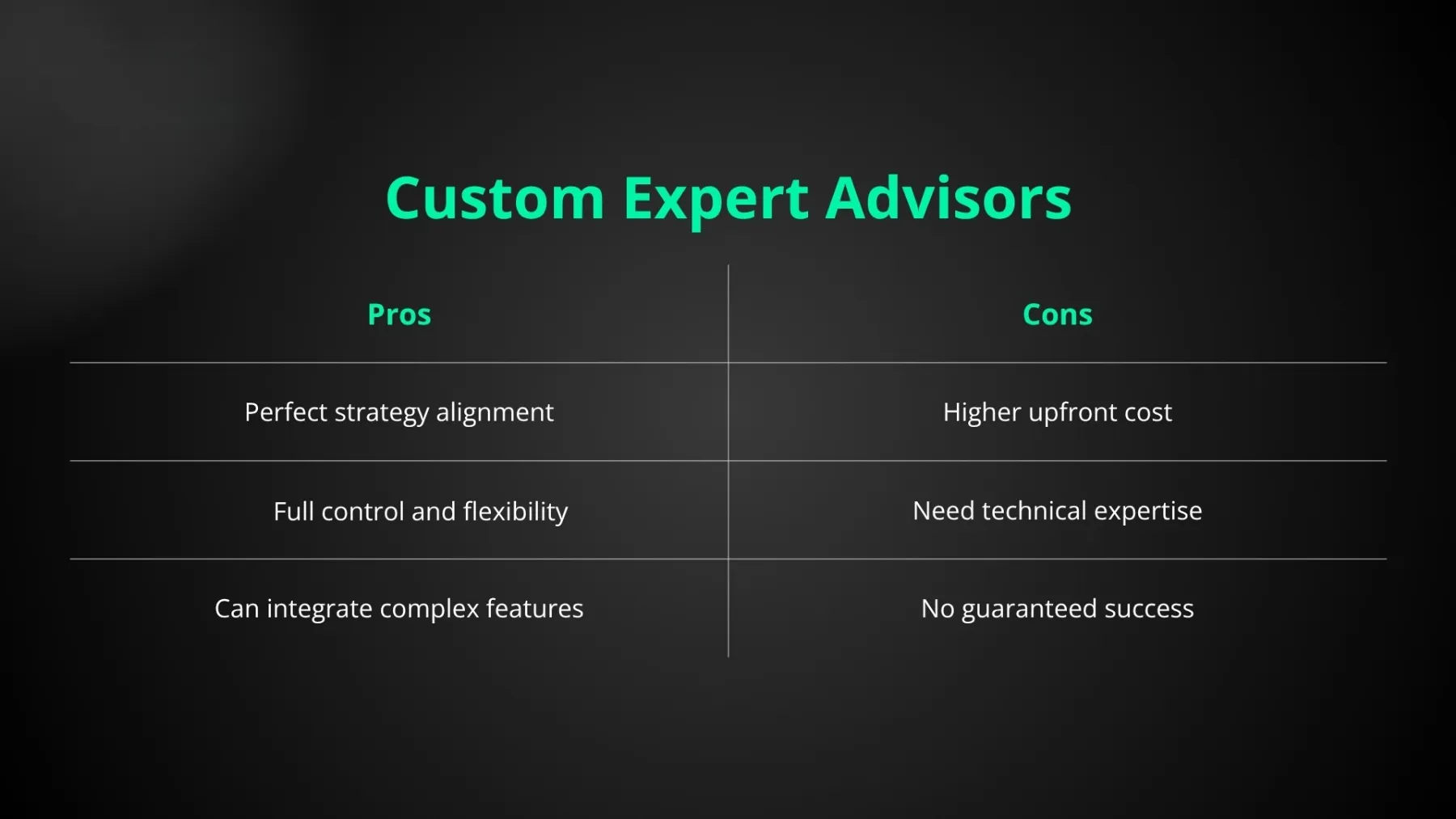
These technical vulnerabilities require constant monitoring and contingency planning.
- Connectivity and Hardware Failure: An internet outage, computer crash, or VPS downtime can prevent the EA from functioning.
- Platform and Broker Issues: Software crashes on MetaTrader or execution delays from the broker can lead to slippage and failed trades.
- Software Bugs: A hidden error in the EA’s programming could trigger catastrophic behavior, such as placing hundreds of trades by mistake.
What Programming Languages Are Used to Create Expert Advisors?
The vast majority of Expert Advisors for retail forex trading are created using proprietary programming languages developed by MetaQuotes Software Corp. Specifically, EAs for the popular MetaTrader 4 (MT4) platform are written in MetaQuotes Language 4 (MQL4). For the newer MetaTrader 5 (MT5) platform, the language is MetaQuotes Language 5 (MQL5). While similar in syntax to the C++ programming language, MQL4 and MQL5 include specialized trading functions that make it easier to analyze price data, place orders, and manage trades directly within the MetaTrader environment. This specialization simplifies the creation of trading robots compared to using a general-purpose language. While it is technically possible to use other languages like Python or C# to connect to broker APIs, MQL remains the industry standard for EAs used on the MetaTrader platforms due to its direct integration and extensive community support.
Understanding these languages is key for traders who want to customize or develop their own EAs.
- MQL4: The older, more widely used language for the MetaTrader 4 platform. It has a massive library of existing code and a large developer community.
- MQL5: The more advanced, object-oriented language for MetaTrader 5. It offers superior backtesting capabilities and greater flexibility for creating complex trading systems.
- Development Complexity: While MQL simplifies many trading tasks, creating a profitable and bug-free EA still requires strong programming logic and a deep understanding of trading principles.